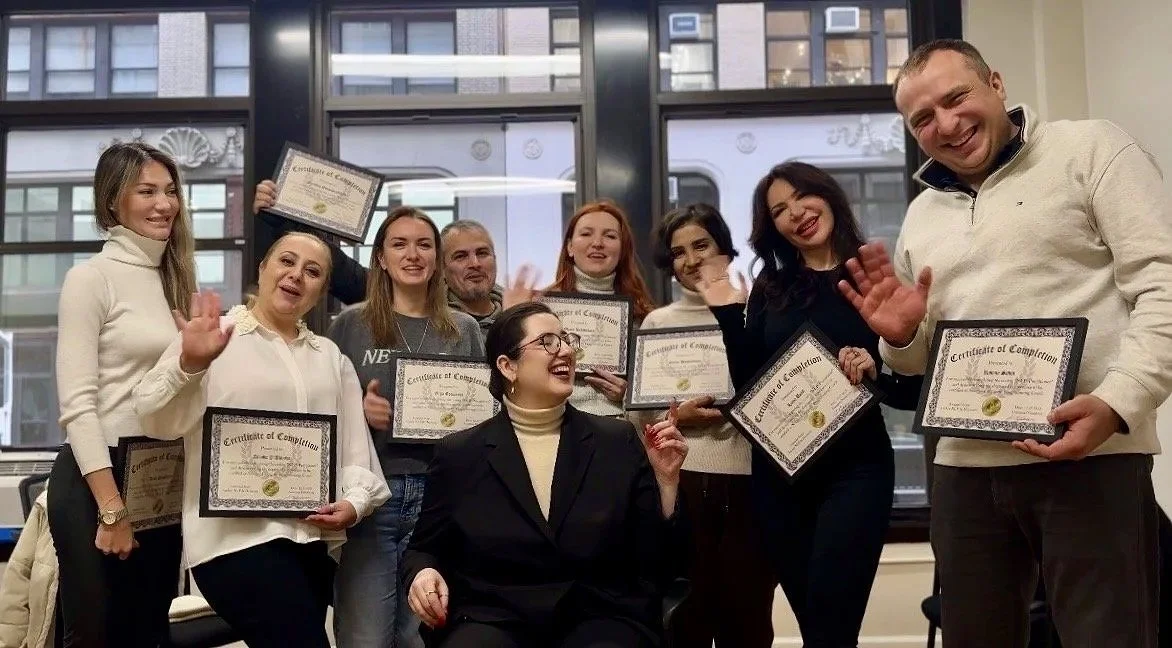
“NLP Practitioner” certification course in the USA
10 weeks to upgrade your thinking and learn to influence.
What is NLP?
Neuro-Linguistic Programming (NLP) is applied psychology, a set of step-by-step techniques, that help you solve challenges quickly and precisely in coaching, psychology, business, communication, marketing, and personal relationships. It is a tool that helps you understand how thinking works, how people make decisions and form emotions and behavior, and how to manage all of this.

The “NLP Practitioner” Course
The NLP Practitioner course is a 10-week program that combines theory, practice, and personal transformation.
Format: in person in New York or online from anywhere in the world
IN PERSON ON SATURDAYS IN MANHATTAN (12:00–3:00 PM)
ONLINE ON MONDAYS AND THURSDAYS (7:00–9:00 PM)
Each session includes step-by-step learning of techniques and live practice in pairs and small groups.
The program is designed so that knowledge immediately becomes skill: you don’t just understand how the mind and language work, you begin to manage your thinking, your state, and your communication.
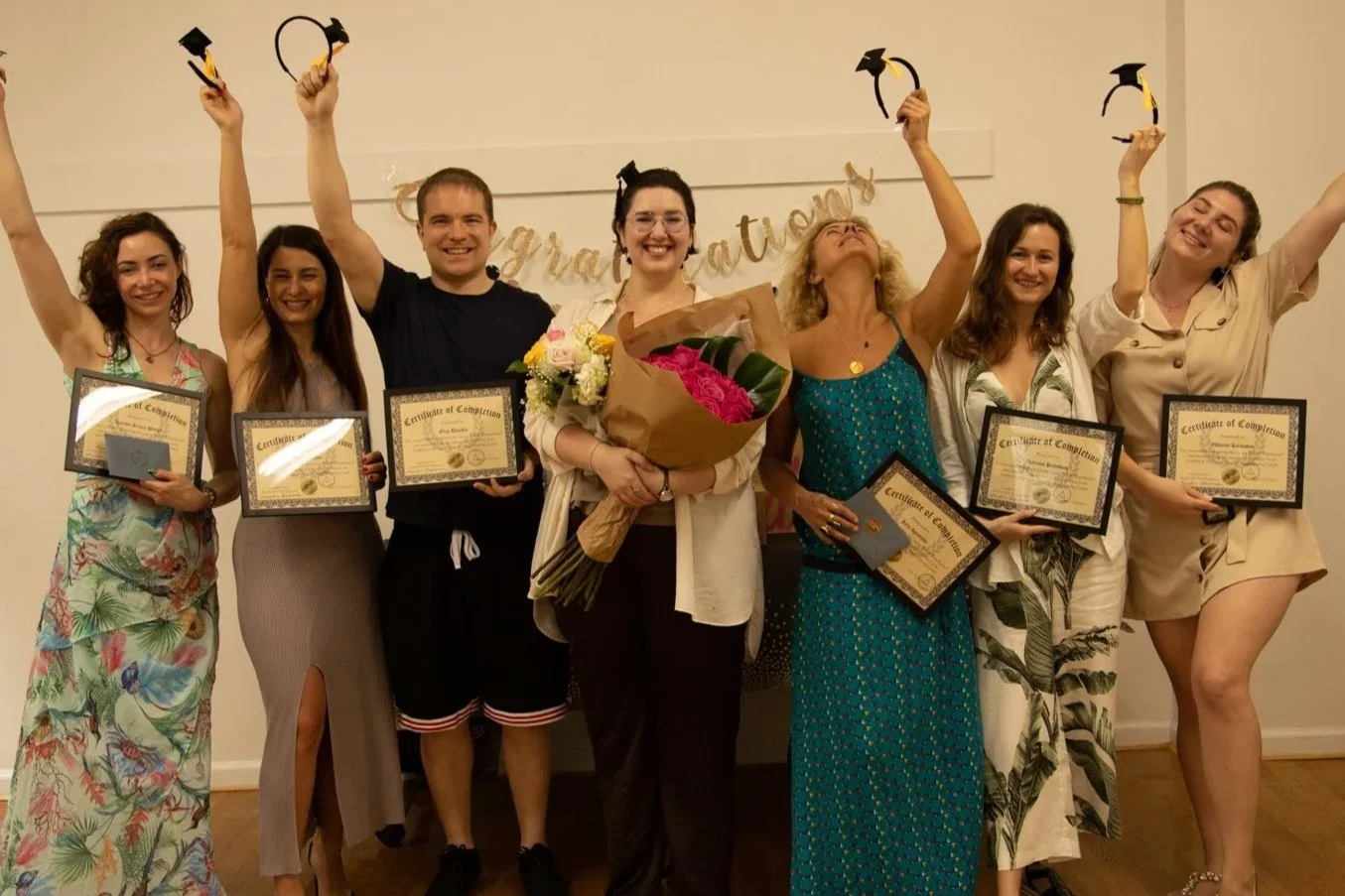
When you finish the course, you receive an international NLP Practitioner certificate, confirming your qualification.
This course is for those who want to master a new profession, upgrade their qualifications, or go through personal transformation, developing awareness, confidence, and flexible thinking.
Certification
Coaching is growing rapidly today, especially in the USA, where coaching is among the most in-demand and fastest-growing professions. More and more people turn to coaches to work through inner barriers, reach their goals, and improve their quality of life.
When you complete the course, you receive:
An NLP Practitioner certificate, confirming your qualification;
Training at a school accredited by the International NLP Association in the USA;
A complete toolkit for working with clients, from clarifying the request to deep transformational techniques;
Practical experience and confidence applying your knowledge to real cases.
An internationally recognized certificate opens up opportunities to work and continue your training worldwide, in coaching, psychology, personal growth, and corporate consulting.

Course instructor
Anastasia Petukhova
Hypnotist
Coach
Certified NLP Master Trainer
Member of the International NLP Association
Founder and lead trainer of Anchor School of NLP and Hypnosis in the USA
This course is for you
if you:
1
Want to master a new profession
You feel ready to help people, inspire them, and guide them to results.
NLP Practitioner will give you a new, in-demand profession as a coach, which is rapidly gaining popularity in the USA and around the world.
You will receive an international NLP Practitioner certificate and can start a career in coaching, psychology, and personal growth.
2
Are a practicing professional in psychology
If you are a psychologist, coach, or therapist and want to grow further, this course will help you adapt your knowledge to international standards.
You will receive a certificate recognized in the USA, and expand your toolkit with modern NLP methods for counseling, therapy, and teaching.
3
Want to improve your relationships with yourself and others
If it matters to you to understand yourself and others, improve relationships with your partner, children, or colleagues, or simply learn to manage your emotions, this course will be your personal breakthrough.
During the training, you will work through your own fears, blocks, and limitations, change your beliefs, release inner tension, and build a more harmonious life.
Course Results

Master practical NLP tools, applicable in coaching, psychology, business, and life.
Learn to manage your state, speech, and behavior.
Be able to accurately understand other people, quickly build trust, and influence their decisions.
Receive an NLP Practitioner certificate and practical skills that will stay with you for life.
Find a community of like-minded people
Course Curriculum
Stage 1. The Art of Communication
Training observation skills and reading nonverbal signals.
Mastering calibration and eye accessing cues.
Building rapport, a trusting connection with the other person.
Understanding representational systems and channels of perception.
Practicing entering resonance and managing the state of another person.
You will learn to inspire liking and trust and easily find common ground with anyone.
Stage 2. Working with the Client’s Request
Foundations of the coaching approach and properly framing the client’s request.
The SCORE technique: gathering information and analyzing the request correctly.
The “Well-Formed Outcome” method: setting precise, achievable goals.
Robert Dilts’ Logical Levels pyramid: diagnosing motivation, values, and inner conflicts.
Understanding secondary gains: the reasons a person doesn’t achieve what they want.
Exploring the shadow side of NLP: hidden motives and resistance.
You will learn to work systematically with goals, requests, and inner limitations.
Stage 3. Behavioral Strategies
The TOTE technique: identifying and modeling successful behavioral strategies.
Magical Goal Achievement: programming the unconscious for results.
Timeline: working with an image of the future and target states.
Cartesian Coordinates: a tool for making difficult decisions.
The Meta Model: exploring the structure of language and clarifying meaning for effective communication.
You will learn to find the best strategies for action, build a results-oriented mindset, and manage the process of reaching your goals.
Stage 4. Perceptual Positions and Negotiation
The three perceptual positions technique: the ability to see a situation from different sides.
Preparing for negotiations by understanding different points of view.
Resolving conflicts without getting emotionally entangled.
The Karpman Drama Triangle: analyzing and preventing destructive interaction patterns.
This stage develops empathy, flexibility, and strategic thinking in communication.
Stage 5. Managing States
The principle of anchoring: creating stable associations and emotional states.
Creating resourceful states: confidence, inspiration, calm.
Collapsing old anchors and replacing automatic reactions.
Anchoring in communication: creating the right associations in others.
Submodality editing: changing how you internally perceive past experiences.
Recoding your attitude toward events and creating a new emotional background.
Context and content reframing: changing the meaning of what is happening.
Studying linguistic patterns of influence for handling objections.
You will learn to change perception and create new, constructive meanings in any situation.
Stage 6. Beliefs and Suggestion
The belief transformation technique: breaking limiting beliefs and building supportive ones.
Systematic work with beliefs using NLP models.
Indirect suggestion: influence through language and speech structure.
Linguistic suggestion patterns: subtly guiding attention and behavior.
You will be able to manage your own beliefs and have a profound effect on how others think.
Stage 7. Trauma and Phobias
The “Movie Theater” technique: working with post-traumatic experiences and phobias.
Processing traumatic experiences safely.
Reducing the emotional intensity of painful memories.
Restoring an inner sense of safety and control.
This module gives you tools for deep therapy and emotional healing.
Stage 8. Inner Conflicts
Analyzing personality structure and the sources of inner conflict.
Parts integration technique: bringing together conflicting aspects of the personality.
Working with inner roles, values, and desires.
This stage helps you achieve inner harmony, resolve doubts, and feel whole.
Stage 9. Changing Behavior
Six-step reframing: a key NLP technique for changing behavior.
Identifying the positive intention behind destructive reactions.
Replacing old behavior patterns with new, healthy ones.
Transforming habits, automatic reactions, and emotional cycles.
After this stage, you will be able to deeply and gently change your own behavioral programs and help others do the same.
Stage 10. Practice and Certification
Working with colleagues’ requests in live practice.
Practical certification exam: you demonstrate how you apply the techniques in a real session.
Review and consolidation of the material.
The final session is devoted entirely to practice, certification, and wrapping up the course.
Apply:

Still have questions?
Contact us in whichever way is easiest for you